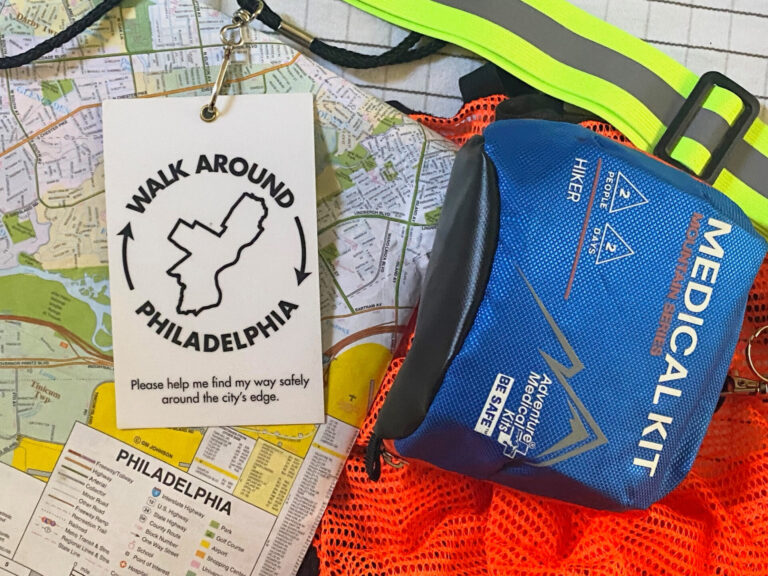
Guidelines & Safety
Walking the city’s edge asks for care — for ourselves, for one another, and for the places we move through.
Guidelines & SAFETY
These guidelines are not rules to enforce, but shared agreements that help create a safer, more respectful, and more meaningful experience, whether you are walking with a facilitated group, with friends, or on your own.
They are offered as orientation, not instruction — a framework for navigating the city’s margins thoughtfully and responsibly.
Staying close to the border (within reason)
The operating principle of Walk Around Philadelphia is to stay as close to the border as possible (within reason) while prioritizing safety.
Perimeter-walkers cultivate an awareness of where the city’s edge actually lies. We balance the desire to make forward progress with the desire to explore those margins. This might mean that rather than staying on the well-traveled sidewalk, we might explore that footpath into the woods that gets us closer to the border.
And while we don’t walk the middle of the Delaware river, we might venture out onto that pier because it gets us closer to the line for a moment, even if we know we’ll have to double back afterwards. This is one of the few projects where you get bonus points for detours & delays.
You
A practice, not a path
Walk Around Philadelphia isn’t a guided tour, and it doesn’t have a fixed path. Rather, it is a collective practice of circumnavigation. Each group makes its own wayfinding choices, and each time it is different. The choices available will depend on direction of travel, season, the year, and each walker’s accessibility needs.
Rather than passively accepting a fixed path, ours is a dynamic practice that balances the pull of the border with the group’s needs and each day’s unique opportunities and observations. There is no “right path”, no wrong way to do it, although we find these guidelines to be helpful.
Prioritizing safety
Participants undertake this walk at their own risk. It is important to prioritize safety & obey the law at all times. We stop and take stock of any changing landscape conditions, and collectively decide how to approach any choices along the way. If ever there is terrain or a situation ahead that feels unsafe to a member of the group, we stop, backtrack, and find a way around it without debate or pressure.
Our walkers might push boundaries in walking places where people don’t usually go, but we aren’t bringing bolt-cutters and breaking into restricted areas. We simply go around them! The greatest risk is always cars, and we approach any situation near traffic with caution and awareness.
Shared Responsibility
Each person who joins our walks is responsible for themselves — and walking together means being responsible for one another.
Whether walking alone or in a group, participants are encouraged to:
- pay attention to their surroundings
- listen to their body and instincts
- make choices that prioritize safety and care
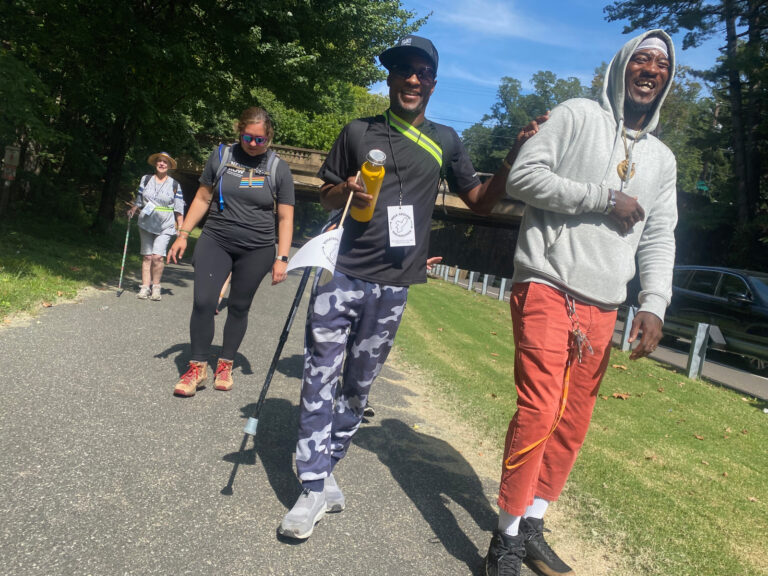
When walking with others, shared responsibility means communicating clearly, checking in, highlighting potential safety issues to each other, and supporting one another’s needs. We don’t charge on ahead without everyone’s consent, and we don’t leave anyone behind.
Pushing boundaries
Exploring the edges of the city gives us opportunities to explore our own edges safely. We might walk longer distances than we usually do. We might walk in unfamiliar or risky places where we might not otherwise explore on our own. We might persevere through adverse weather and discomfort. We might navigate unfamiliar conversation dynamics with someone whose background is different than ours. All of these are opportunities for growth, discovery & learning.
Honoring boundaries
Exploring the city’s limits also gives us opportunities to honor our own, and those of others. We might have thought that the distance would be manageable, but maybe our body tells us that it’s time to peel off early and rest. We might want to cross that stream, but if it doesn’t feel safe for one of our fellow walkers we’ll make another choice. If someone asks something of us that we don’t feel comfortable with, we’ll find a clear and warm way to hold our own boundaries.
Knowing when not to push oneself further is as important a part of the walk as choosing to take a risk.
-> More on accessibility & support
Starting together
For us to walk together, we have to start together. Each walk starts with an orientation which provides an opportunity to review the itinerary and process as well as to make introductions and answer questions. This creates the container that will hold our day’s adventure.
You can always leave a walk before its planned end if you need to, but you generally can’t intercept one of our groups mid-way once we’re underway. Please be on time or early for the start of a walk! You’ll find that even before the official ‘start time’, the walk experience has already begun: you don’t need to wait for a facilitator to start noticing your surroundings or introduce yourself to a fellow walker.
Staying together &
Calling breaks
Part of walking together means keeping the group together. If one is used to walking swiftly, it can be an interesting challenge to slow one’s pace to match that of a slower walker, but this can also provide opportunities to notice things as little as a small insect on the trail or as large as our own impatience.
Anyone in the group can call a break at any time. Calling out “Hey, hold up!” is the way that we generally do it. You can call a break because you need to rest, or to let someone else catch up, or because you want to discuss route options, or just because you’d like to take a closer look at something. Remember, the walk is less about getting to a destination than it is about exploring the edges.
Once a group has stopped, anyone can also begin the process of resuming the walk. Rather than charging on ahead, the way that we do this is by checking in with each other: “I’m feeling ready to get moving again… is everyone else ready to get moving again?”
Navigating risks
Traffic is generally our greatest risk, but sometimes there might be other challenges like difficult terrain or wandering into a place where we aren’t wanted. Whether approaching a traffic crossing or a stream crossing or any other potentially risky situation, we stop and check in with each other and find a course of action that feels acceptable for the entire group.
If we perceive a risk (whether to ourselves or to others) it is our responsibility to speak up and voice it. If this section sounds duplicative of the “Prioritizing Safety” section above, it is because it bears repeating!
Navigating Obstacles
When setting out to follow the city border, we inevitably encounter obstacles. To navigate these, we simply walk around them. We call this the “Roomba Rule“, named after those little robot vacuum cleaners, and how as they explore the edges of a new space they might bump their way around obstacles until they find a way through.
It turns out that with enough patience, this strategy works for obstacles of any size.
This means that while the perimeter-line itself may be fairly straightforward, the path that our walkers take often isn’t. And it’s in those zigzagging detours that we take as we work our way around obstacles that we find special moments of discovery.
Treat everything and everyone with curiosity and Respect
In setting out on our walk, we strive to treat everything and everyone that we encounter with curiosity and respect.
We might like one landscape more than another (say a beautiful forest path versus a busy intersection that is treacherous for pedestrians) – or find one encounter with nature (stumbling across a herd of deer) preferable to another (encountering one of those same deer as roadkill) but in setting out to do our walk we accept it all as part of the experience.
There are also opportunities for drawing lines between us and our fellow walkers or people that we meet along the way: lines of class, politics, religion, culture, etc… but rather than falling into familiar patterns of “us” and “them”, we marvel at the fact that here we are, all of us out here navigating our boundaries together. What can we learn from each other?
Step up / step back
Maybe you are one of those people who is used to being in charge, at the front, in a leadership role, providing directions. Maybe you’re comfortable reading maps, feel like you know the right way to go, and are usually the first person to chime in with a suggestion.
If you’re used to leading… here is your opportunity to set boundary and contain yourself:
Can you step back and let someone else lead? What is it like to stay quiet so that someone else might have room to speak up? Can you follow and support so that everyone can have a turn leading?
Maybe you are just along for the ride. You might not usually be comfortable speaking up or taking charge, especially not in this scenario if reading maps isn’t your thing.
If you’re used to following, here is your opportunity to push your boundaries, safely:
Can you step up to the front of the group, and help scout out the way ahead? What is it like to ask someone to orient you to the map and figure out where the border is, so that you might propose our next steps? What is like to start a conversation and ask questions of your fellow walkers, even if you’re shy?
Presence & attention
Phones, maps, and cameras are welcome tools for navigation and documentation. Participants are encouraged, when possible, to limit distractions and stay present with the group and the place.
You can share photos, reflections, and stories later. While walking, the invitation is to notice more deeply.
You might also notice who is not present with you. What would it be like to walk with different people?
Who might not yet have received our invitation to explore the city’s edge? Who might have obstacles preventing their participation? How can we work to make this unique experience of the city more accessible to all?
-> More on accessibility and support
Weather & PREparation
Walking happens in many conditions, and those conditions may change quickly. Participants are encouraged to check the latest forecasts, dress appropriately, prepare thoughtfully, and adjust plans as needed. Make sure to review the packing list!
Weather, delays, and detours are part of the experience. Preparation helps, but flexibility matters just as much.
EMERGENCIES & SUPPORT
Participants are encouraged to:
- carry an emergency contact, relevant medical information & medication
- let fellow walkers know if support is needed
- seek professional help when necessary
Facilitators can help coordinate support, but they are not medical professionals. In emergencies, call 911.
A minimum group size of 4 is recommended for any DIY experience.
A shared practice of caretaking
These guidelines are not meant to cover every situation.
Walking the perimeter means responding to what actually unfolds — together.
Care, safety, and respect are ongoing practices shaped by the group, the place, and the moment.
Where to go next:
Use a clear and attention-grabbing short paragraph to engage your audience and draw them into reading the rest of your content.
How we work to make these experiences accessible to all
All your questions… answered!
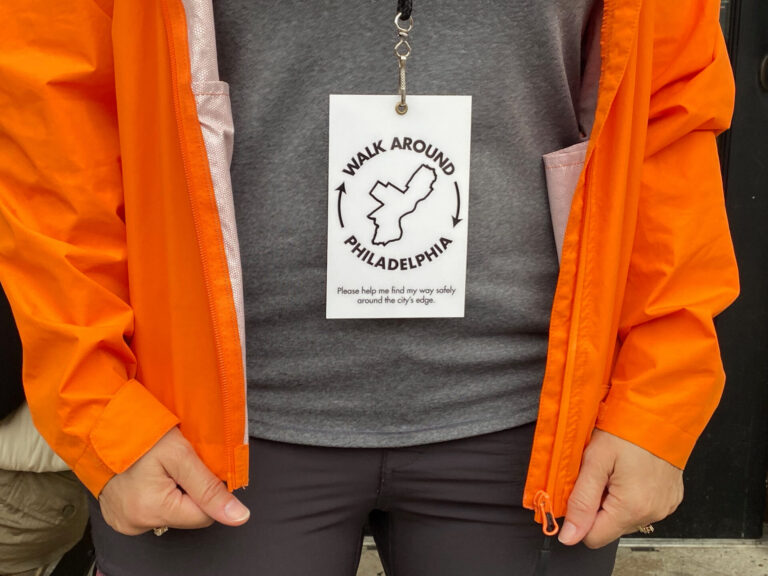
You don’t need much, but here are some considerations