Accessibility
Access as a shared practice
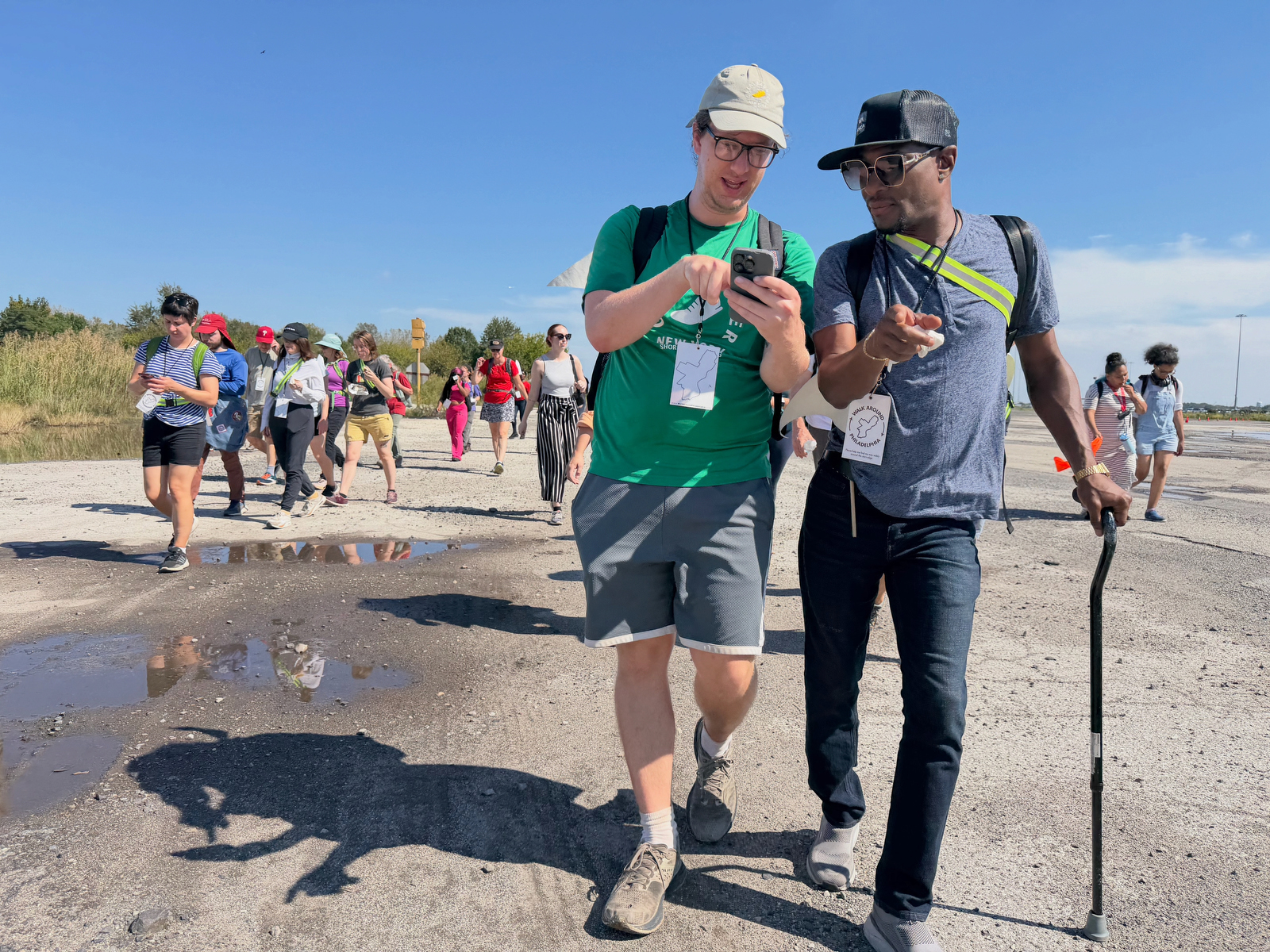
There is no single “accessible” way to walk the city’s edge. Bodies, schedules, comfort levels, resources, and trust vary widely — and all of that matters.
Accessibility in the Walk is not about meeting a fixed standard. It’s about:
- naming barriers openly
- offering multiple ways to participate
- honoring limits and choices
- staying in conversation about what support is needed
We invite participants to engage in ways that are suitable for them.
Accessibility is central to Walk Around Philadelphia.
It is also an ongoing practice — shaped by the city’s terrain, available resources, and the needs of the people who show up.
We work to reduce barriers wherever we can, and we continue learning how to do better.
Physical access, Terrain and pacing
Much of the terrain along Philadelphia’s border poses real physical accessibility challenges. Walks may include uneven sidewalks, dirt paths, mud, stairs, industrial landscapes, long stretches without seating, and areas shaped by heavy infrastructure.
Our guidelines allow for flexibility. Walkers regularly:
- go around obstacles
- choose alternate paths
- adapt routes to meet group needs
At the same time, we want to be clear: some terrain traversed by many perimeter walks is not accessible to wheelchair users, and some segments may be challenging or impossible depending on mobility needs.
To support physical access where possible:
- walks happen at a shared, adaptable pace
(Unless otherwise noted, we aim to cover 2 miles per hour) - breaks are regular and encouraged
- participants may join for partial segments
- leaving early or heading home is always welcome
Listening to your body — and respecting and supporting the needs of others — is part of walking well.
Learning about terrain in advance
We offer in-person and virtual info sessions and planning gatherings where participants can:
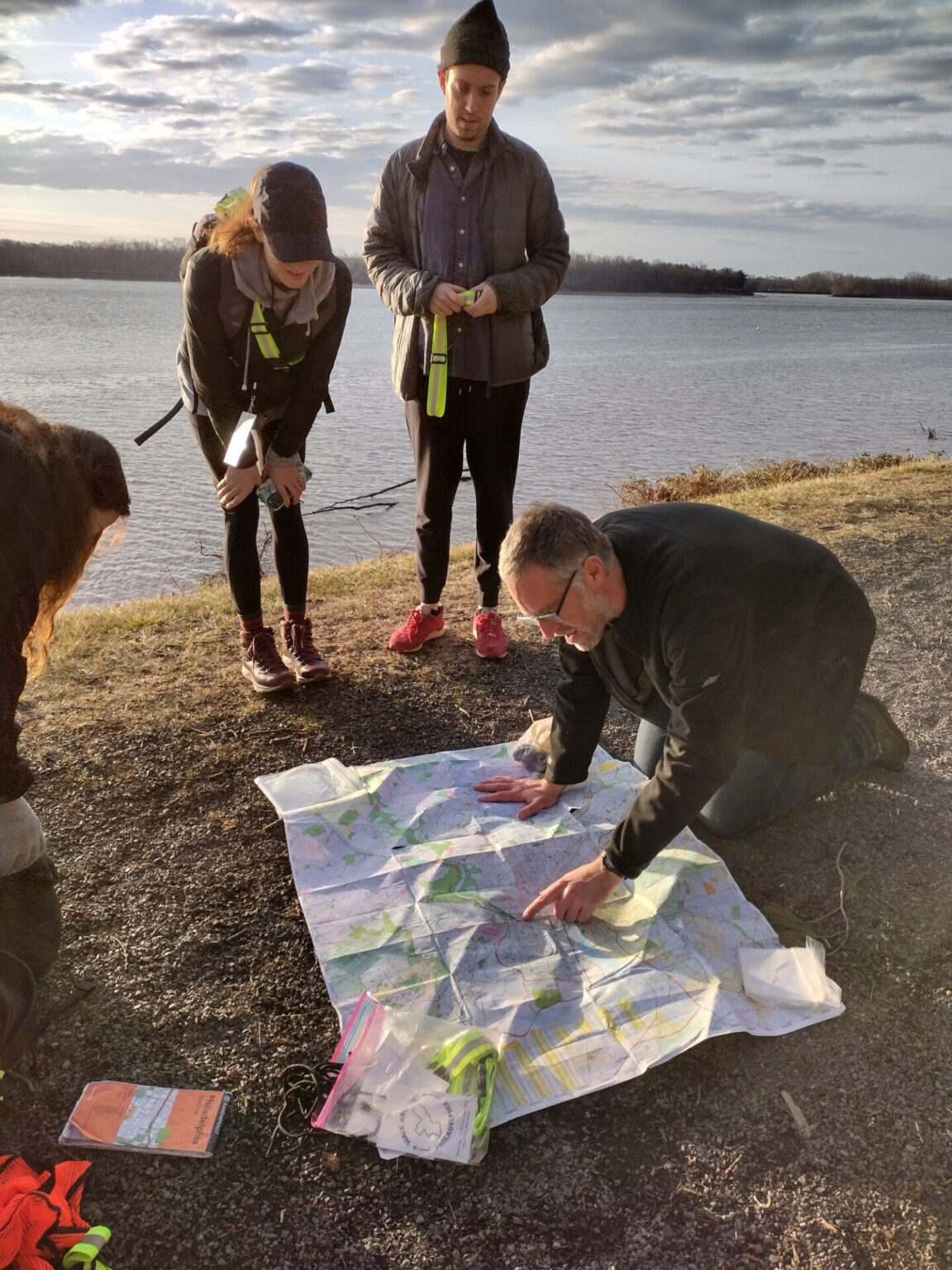
- look at maps together
- discuss potential terrain challenges
- ask questions about access, pacing, and conditions
- learn from others’ experiences on specific segments
These sessions are a key way we support informed participation and shared decision-making.
Expanding accessible options
While our February and September walk cycles are made up of longer segments (often around 10 miles), participants are always welcome to start with a partial segment.
We are also actively developing:
- medium-length walks (around 5 miles)
- short walks (1–2 miles)
- accessible events and gatherings near the city’s edge that do not require walking at all
These offerings create additional entry points into the project and allow people to participate in ways that fit their bodies, time, and energy.
Age, mobility, and many ways of participating
There is no single age or ability profile for Walk Around Philadelphia participants.
-> Our youngest circumnavigator completed the full perimeter at age 11 with a group of fellow homeschooled youth.
-> Our eldest participant completed the perimeter at age 94, traveling with his daughter and getting out to walk at points of interest as he was able.
There are many ways of walking the walk.
Time, capacity, and long horizons
Most participants do not complete a full perimeter cycle in one season — or even in one year.
Many people:
- begin with a single segment
- return for another when time allows
- complete their first full loop over several years
This long horizon is intentional. The Walk is designed to be revisited, paused, and resumed — fitting into real lives rather than demanding priority over them.
Financial access
In a city where 20% of our neighbors are facing financial hardship, we work to make participation financially accessible.
- Sliding-scale contributions are optional
- No one is turned away for lack of funds
- Stipends are offered when possible ($200/walker/day)
Our long-term goal is for 20% of each group to be stipend-supported and for our participant pool to represent the region’s demographics.
Participants who have the means to may also choose to support access for others through pay-it-forward contributions that help fund stipends.
/butt
Language access and Literacy
We aim to use clear, plain language and to create space for questions.
We have piloted programs specifically for Spanish- and French-speaking participants, and we aim to develop offerings in additional languages as our capacity grows.
We are also building a roster of walkers who speak languages other than English and can accompany participants while offering support in a shared language.
We also recognize that literacy is a barrier to many in our region, and plan to develop more video content to invite and support potential participants as our capacity grows.
-> See our roadmap for growth
/butt
Setting out on your own (DIY)
For those who cannot or prefer not to join a facilitated group walk, a self-guided (DIY) option is available. This allows participants to engage on their own schedule and at their own pace.
DIY walkers are always welcome to:
- re-walk a segment later with a group
- attend events and participate in exhibitions
- connect through discussion forums and shared stories
Some DIY walkers choose to become Trail Angels — offering snacks, support, encouragement and local knowledge to our groups of walkers.
DIY participation can also be paired with pay-it-forward support via our stipend fund, helping make the Walk more accessible to others.
-> DIY registration
/butt
An open invitation
If you’re unsure whether a walk is a good fit for you — or if you have specific access needs, questions, or ideas — we invite you to attend one of our info sessions or reach out. We’re glad you’re here, and we’re committed to continuing this work together.
Where to from here?